

2.1.5.4.2.1. The SRES scenarios
Socio-economic scenarios were introduced in the Third Assessment Report (TAR) of 2001 and also used in the Fourth Assessment Report (AR4). The Special Report on Emissions Scenarios1 contained so-called ‘SRES scenarios’, which were in fact narrative storylines that explored different pathways of global socio-economic, technological and environmental development, each with their own emission characteristics.
SRES included four main families of scenarios, each representing different socio-economic futures summarized here:
A1 scenario family
The A1 storyline and scenario family describes a future highly interconnected world of very rapid economic growth. Population growth peaks mid-century and then declines, reflecting advances in education, healthcare, and economic development that lead to lower fertility rates.
The world experiences unprecedented economic expansion, with rapid increases in living standards and widespread access to goods and services, and technological progress with significant advancements in energy, transportation, and communication technologies.
The A1 scenario family develops into three groups that describe alternative directions of technological change in the energy system. The three A1 groups are distinguished by their technological emphasis:
• fossil intensive (A1FI),
• non-fossil energy sources (A1T), or a
• balance across all sources (A1B).
A2 scenario family
The A2 storyline and scenario family describes a very heterogeneous world, with nations and regions prioritizing self-reliance and local identities over global integration.
Population growth continues to increase throughout the 21st century. Limited advances in education and healthcare, particularly in developing regions result in slower reductions in fertility rates.
Economic development is uneven and regionally constrained, with slower growth rates compared to other scenarios.
Technological change occurs at a slower and more uneven pace, primarily driven by regional capabilities and priorities.
Energy systems remain dominated by fossil fuels, with limited adoption of clean technologies due to slower economic growth and weaker global cooperation. High population growth and limited technological advancement exacerbate environmental pressures, that are unequally mitigated, resulting in continued environmental degradation in many regions.
B1 scenario family
The B1 storyline and scenario family describes a convergent world with the same global population that peaks in mid-century and declines thereafter, as in the A1 storyline, but with rapid changes in economic structures toward a service and information economy, with reductions in material intensity, and the introduction of clean and resource-efficient technologies.
The emphasis is on global solutions to economic, social, and environmental sustainability, including improved equity, but without additional climate initiatives.
B2 scenario family
The B2 storyline and scenario family describes a world in which the emphasis is on decentralized decision-making and local solutions to economic, social and environmental sustainability. It is a world with continuously increasing global population at a rate lower than A2 but higher than in B1, intermediate levels of economic development, and less rapid and more diverse technological change than in the B1 and A1 storylines.
While the scenario is also oriented toward environmental protection and social equity, it focuses on local and regional levels.
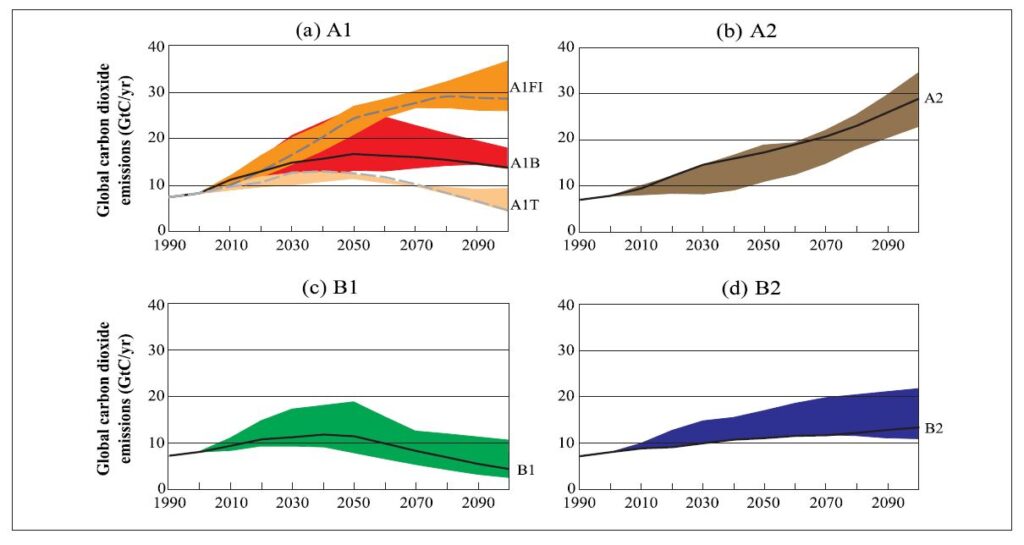
Evaluating the SRES scenarios
Compared to earlier emissions scenarios, the SRES represented a significant advancement in climate modeling. It incorporated updated data and insights into plausible future emissions trajectories, reflecting the complex interplay between population growth, economic development, technological progress, and energy systems. The key strength of the SRES was its ability to explore these interdependencies through narrative-driven scenarios (A1, A2, B1, B2), each representing a distinct pathway for economic development, technological innovation, and greenhouse gas emissions.
The SRES scenarios accounted for both global and regional differences in development, enabling assessments of varying climate impacts across regions. By providing detailed projections of population and economic growth, energy demand and production by source, land-use changes, and emissions of greenhouse gases and aerosols, the SRES allowed climate models to generate more refined projections of temperature, precipitation, and other climate variables.
However, the SRES scenarios had notable weaknesses. Their narrative storylines, combined with quantitative modeling, introduced a level of complexity and “fuzziness” that made it challenging to establish clear, consistent relationships between socioeconomic assumptions and emissions outcomes. This was particularly evident in the A1 scenario family, where the sub-variants (A1FI, A1B, and A1T) spanned nearly the entire spectrum of emission trajectories (see Fig. 12). This wide variability often led to confusion about how to use and interpret the scenarios.
Another limitation was their focus on emissions as the drivers of global warming rather than on their effects. As a result, the SRES scenarios were unable to account for the impact of emission-reduction policies.
Due to these shortcomings, the SRES scenarios were replaced in the IPCC’s Fifth Assessment Report (AR5) by the Representative Concentration Pathways (RCPs), which shifted the focus to the direct impacts of different atmospheric concentrations of greenhouse gases on global warming.
More info on Representative Concentration Pathways
NOTE
During my time at ICARDA, we utilized SRES scenarios in several climate change studies, as documented in publications 77, 89, 93, 94, 108, and 109.
1 Reference: IPCC 2000. Emission scenarios. Special Report of the IPCC Working Group, 27 pp.