
Implementing Integrated Land Use Planning: A step-by-step guide for rural areas
INTRODUCTORY GUIDE: CHAPTER 1. NATURE AND SCOPE
1.2. LAND USE PLANNING
1.2.3. Participatory land use planning
Modern land use planning approaches emphasize the principle of ‘devolution,’ where primary land users, such as farmers and herders, are recognized as key participants in the planning process. This includes other actors who use land for various purposes, such as settlements, forestry, energy sources, industry, mineral extraction, recreation, and tourism.
The concept of ‘stakeholder’ is central to land use planning today. The FAO defines a stakeholder as: “any person or institution with an interest in, or who is affected by, an issue, activity, or transaction, and therefore has a natural right to participate in decisions relating to it” (FAO/UNEP 1999). This definition underscores that those whose livelihoods and well-being could be impacted by proposed changes in land use should be at the heart of the decision-making process.
Managing the interests of diverse stakeholders through structured participatory negotiation processes has thus become an essential part of land use planning (Bourgoin et al., 2012; Bonnal, 2013; Tarrason et al., 2017). This process can be particularly challenging.
The main objectives of participatory land use planning are to empower stakeholders to assess the current situation and enable them to implement necessary changes (Fig. 4). This approach acknowledges that stakeholders—due to their intimate knowledge of the land—are in the best position to express their needs and aspirations for change. Once these needs are identified, stakeholders can drive the planning process toward achieving the desired outcomes.
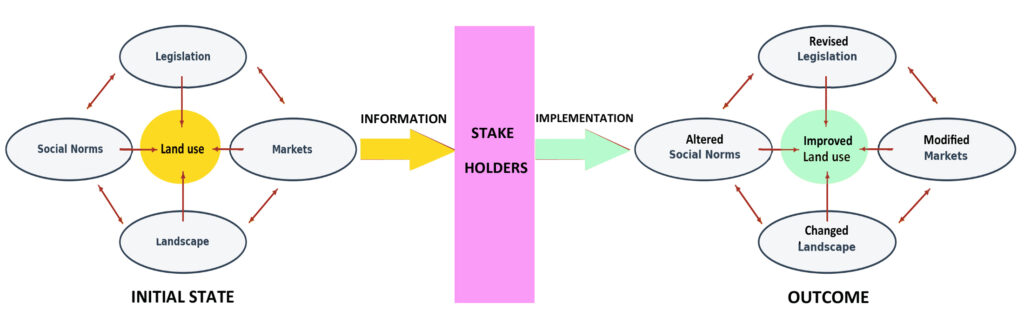
In summary: in participatory land use planning, the diverse group of stakeholders is not only responsible for analyzing land use issues but also plays a crucial role in implementing the changes identified through the planning process.
1.3. Why Is Land Use Planning Needed?
Given global population growth, increasing pressure on land resources, land degradation, biodiversity loss, and climate change, effective land and resource planning is more critical than ever.
Land use planning is a vital tool for promoting sustainable land resource management, typically implemented at the national level. Effective examples of land use planning include resolving conflicts between farmers and pastoralists, restricting urban development in flood-prone areas, regulating excessive pesticide and fertilizer use while encouraging organic farming, and promoting land management practices that prevent soil erosion, compaction, and pollution. It also involves facilitating equitable land tenure arrangements, developing legal frameworks for land consolidation, and creating biodiversity reserves for plants and wildlife.
In the long term, land use planning offers significant economic benefits. The examples above highlight how relatively small investments in planning can help avoid the high human and material costs associated with conflict, natural disasters, land loss, land and water degradation, or the extinction of species.