
Implementing Integrated Land Use Planning: A step-by-step guide for rural areas
INTRODUCTORY GUIDE: CHAPTER 1. NATURE AND SCOPE
1.6. Emerging issues in land use planning
1.6.2. Restoration of Degraded Land, Land Degradation Neutrality, and Biodiversity Maintenance
Restoration of Degraded Land
The 73rd session of the UN General Assembly formally adopted a resolution declaring 2021–2030 as the UN Decade on Ecosystem Restoration (UN-DER), aiming to prevent, halt, and reverse ecosystem degradation worldwide. Achieving UN Sustainable Development Goal (SDG) No. 15—’Life on Land’—which focuses on protecting, restoring, and promoting the sustainable use of terrestrial ecosystems, sustainable forest management, combating desertification, and halting land degradation and biodiversity loss—depends entirely on land resources and requires careful planning.
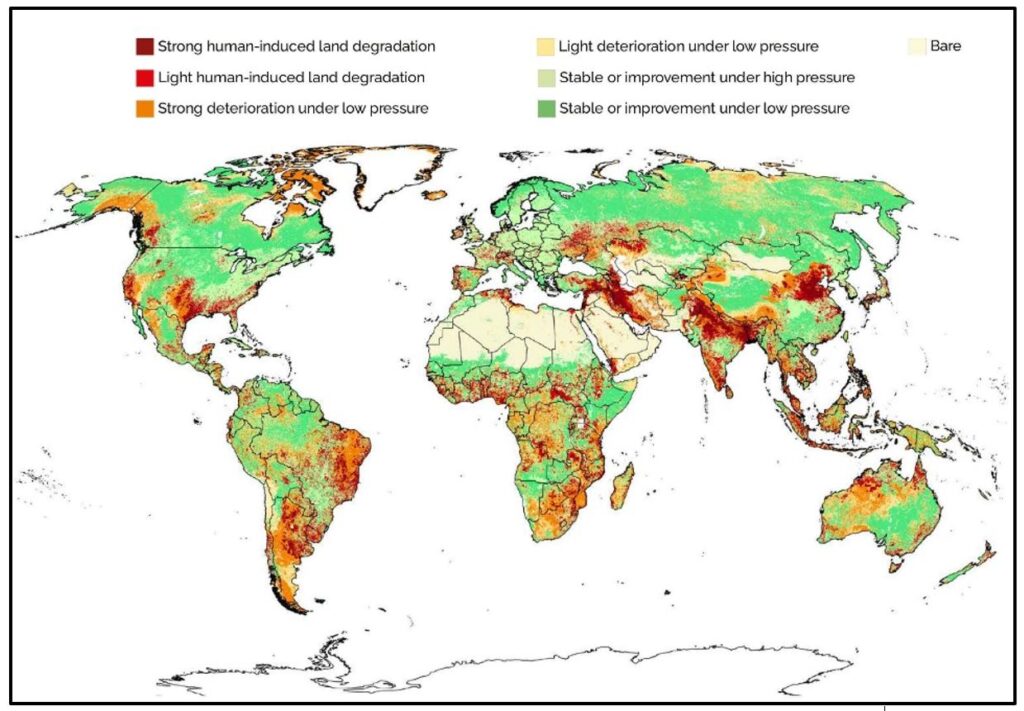
Restoring degraded land is crucial for ecosystem resilience, food and nutritional security, and biodiversity recovery (Dubey et al., 2021). As a result, international initiatives such as the Bonn Challenge [1] and the New York Declaration on Forests (NYDF) [2] prioritize land restoration. According to the IPBES (2018) global assessment on land degradation and restoration, 75% of the global land area has already been significantly modified, with 90% expected to be significantly altered by 2050. Figure 9 illustrates the distribution of global land degradation based on trends and direct human pressures (FAO, 2022).
Land Degradation Neutrality
Land restoration is central to the concept of Land Degradation Neutrality (LDN), introduced by the United Nations Convention to Combat Desertification (UNCCD) and adopted at the Rio+20 conference in 2012. LDN recognizes the urgent need to reverse land degradation and aims to maintain or enhance ecologically healthy and productive land resources while aligning with national sustainable development priorities. To achieve this, land conservation, sustainable management, and restoration must be integrated into land use planning (UNCCD and FAO, 2020).
Restoration strategies depend on the specific ecosystem and the causes of degradation (Santini & Miquelajauregi, 2022). Methods include:
• Reforestation to restore forest ecosystems (Gastauer et al., 2020).
• Reseeding to provide vegetation cover and prevent erosion in rangelands (Stock et al., 2020).
• Conservation tillage and nutrient replenishment to restore poor soils.
• Wetland restoration to recover natural hydrology in rivers and lagoons (Santini et al., 2019).
At the district level, the LADA framework (Liniger et al., 2013) provides a structured approach to deciding which action is most appropriate:
• Prevention: Applying conservation measures to maintain natural resources and their environmental and productive functions on land prone to degradation. This approach assumes that good land management practices are already in place and acts as the opposite of human-induced degradation.
• Mitigation: Intervening to slow or halt ongoing degradation. This is implemented when degradation has already begun, aiming to prevent further deterioration and start improving resources and their functions. Mitigation measures often show short- to medium-term results, encouraging continued efforts.
• Rehabilitation: Addressing land degradation that has rendered the land unproductive. This requires long-term, often costly investments to restore functionality.
Despite these efforts, ecosystem restoration is often challenging. Strategies are highly site-specific, and successful approaches in one region may not be transferable elsewhere. Restoration requires long-term commitment, sometimes spanning decades or even centuries, with ongoing management often necessary (Yang et al., 2020). For example, restoring soil organic carbon may take significantly longer than regenerating above-ground grassland biomass (Moreno-Mateos et al., 2012; Hu et al., 2018). Additionally, the role of local communities and Indigenous peoples is often a key factor in successful land restoration (Santini & Miquelajauregi, 2022).
Maintaining biodiversity
Biodiversity conservation is essential for sustainable land use and benefits from collaboration between ecologists, who study natural systems, and planners, who balance social, environmental, and economic priorities (Gagné et al., 2020).
The leading cause of species endangerment is habitat loss, primarily driven by agricultural expansion and urban sprawl. Agriculture already occupies about 40% of the world’s ice-free land, and future projections suggest further expansion and intensification. The manner in which this occurs will have profound implications for biodiversity. This is particularly critical in Sub-Saharan Africa, where food demand is expected to rise significantly.
For biodiversity conservation to influence land-use planning effectively, objective systems for ranking natural areas for protection or conversion must be developed. However, creating spatially explicit biodiversity indices is challenging due to the complexity of measuring and combining relevant variables. A study comparing biodiversity assessment methods in Zambia for agricultural land-use decisions highlights the urgent need for a more consistent and transparent framework in biodiversity planning (Crawford et al., 2021).
Even in industrialized countries, biodiversity data remains a significant constraint on conservation planning, as the spatial resolution of available data often does not match the scale of habitat fragmentation (Gaston et al., 2008).
To enhance biodiversity conservation in local land use plans, conservation biologists should:
• Educate the public about local conservation priorities and the benefits of biodiversity.
• Promote ecological literacy and improve communication on biodiversity issues.
• Foster collaboration among different jurisdictions to support conservation efforts.
• Advocate for the inclusion of biodiversity specialists in land-use planning teams (Stokes et al., 2010).
At the national level, strengthening and quantifying legal frameworks for conservation planning is essential.
Conclusion
Biodiversity is a crucial factor in land use planning, and including ecologists in planning teams is imperative. The lack of biodiversity data and standardized priority ranking methods for conservation necessitate urgent research and policy action.
NOTES
[1] The Bonn Challenge is a global effort to restore 150 million hectares of the world’s degraded and deforested lands by 2020 and 350 million hectares by 2030.
[2] The New York Declaration on Forest pledges to halve the rate of deforestation by 2020, to end it by 2030, and to restore hundreds of millions of acres of degraded land. The declaration is voluntary and not legally binding.