

2.1.5.3.1. Comparing farmer perceptions and realities of climate change in Jordan
An NCARE team, led by Dr. Samia Akroush and Ms. Muna Saba, conducted a farmer perception survey among older farmers in two localities in western Jordan, Rabba, near Karak, and Al Hassan, near Tafileh. They developed a questionnaire, with which they interviewed individual farmers, and led focus group discussions with farmers to capture their understanding of climate change based on memories and past experience.
The ‘Climate Change Living Memory Survey’, as it was officially called, came to the following synthesis of farmer perceptions of changes in the rainy season and rainfall:
• Perception 1: a general decrease in total rainfall amounts.
• Perception 2: a delay in the beginning of the rainy season; where it used to start in September, October but mostly in November, it is currently delayed till January and February.
• Perception 3: the rainy season nowadays stops in March and no rainfall is received in April (though this month is regarded as crucial for the crop production).
• Perception 4: whereas rainfall used to be well distributed all over the season, currently most is concentrated in January and February.
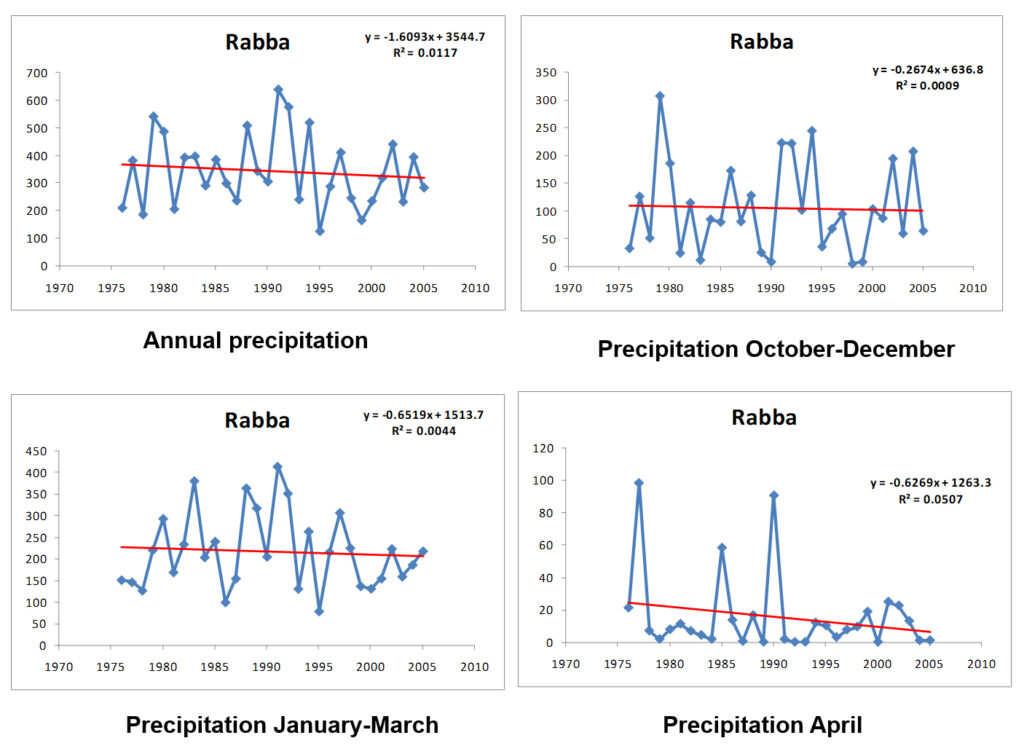
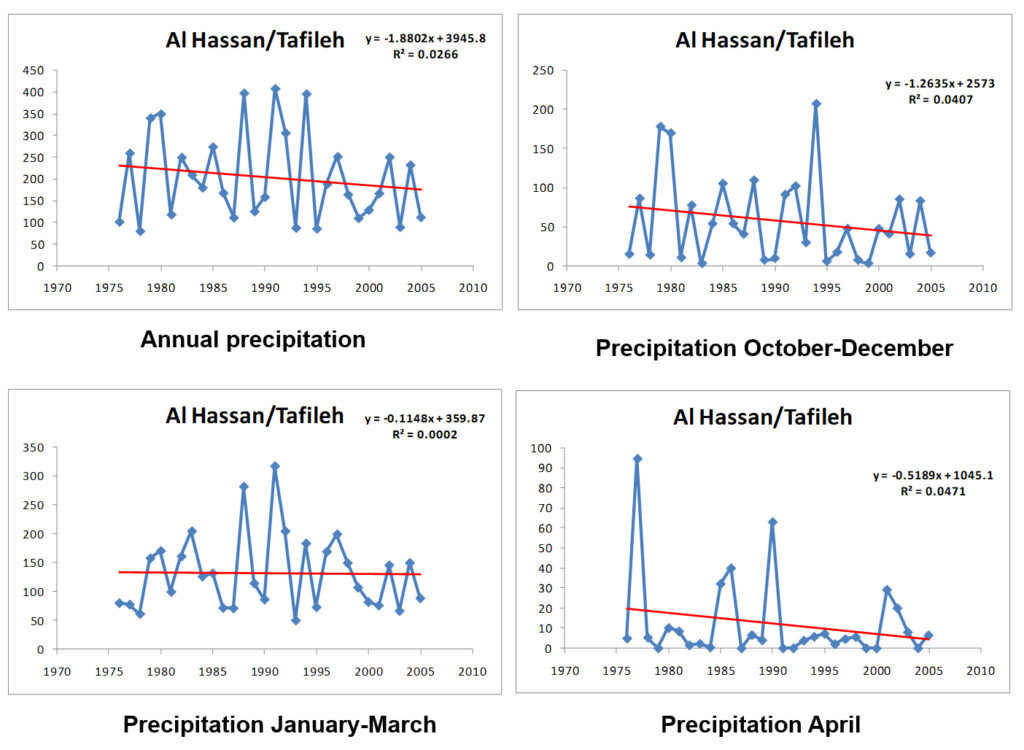
When we compare these perceptions with actual rainfall data from 1975 to 2007 (see Figures 8 and 9), both alignments and discrepancies between perceptions and reality become apparent:
• Perception 1: farmers noted a decline in annual precipitation, which matches the data showing a decrease in rainfall in both Rabba and Al Hassan/Tafileh. This trend aligns with the long-term regional pattern of declining precipitation in West Asia over the past 100 years (more details here).
• Perception 2: there was a noted decrease in rainfall from October to December in Tafileh, partially supporting farmers’ perceptions. However, there is no evidence of a decline for Rabba.
• Perception 3: a decrease in April precipitation was observed in both Rabba and Tafileh, confirming the farmers’ perception.
• Perception 4: there is no evidence for this perception, as January to March rainfall has remained stable in both locations.
It is noteworthy that none of the observed precipitation trends are statistically significant. However, that does not mean that these trends are not real: even the stronger trends are masked by the large inter-annual variability. It is therefore all the more remarkable that farmers did indeed recognize some major precipitation trends. At the same time, it is not surprising that farmers saw some trends where none exist, since the large precipitation variability is likely to evoke the natural response of looking only at the more recent past.
Proper extension work to effectively address climate change needs to take into consideration farmer perceptions, and where needed, align them with reality. In this particular case, there is an agreement between what farmers see as a general drying of the climate and the observed trend of precipitation decline. This will be easier to convince farmers of the need for adapted crop choices or soil moisture conservation techniques. For more specific adaptation packages for farmers, a better understanding of in-season likely changes will be required.
A similar study, undertaken by Ms. Auerbach with Bedouins in southern Jordan, similarly identifies misunderstandings of the essence and causes of climate change. This problem leads to fatalistic attitudes (‘it’s the will of God’) and explains the absence of plans to manage risk and why farmers do not recognize appropriate adaptation strategies.
The case study in Jordan illustrates that farmer perceptions are likely to be shaped by the region’s arid climate, where water scarcity is a significant concern. Jordanian farmers thus tend to perceive changes in precipitation and water availability as critical challenges, whether they result from climatic variability or longer-term change. Understanding their perspectives can provide valuable insights into how climate change is experienced on a local level and inform more tailored adaptation policies, ranging from changing crops or varieties to improving water-use efficiency. Any significant gap between perceptions and understanding of climatic change will make it difficult to promote appropriate adaptation measures. More investment in public awareness campaigns is likely to be money well spent.
More details and regional context on this topic here.