2.1. Weather, Seasons and Climate
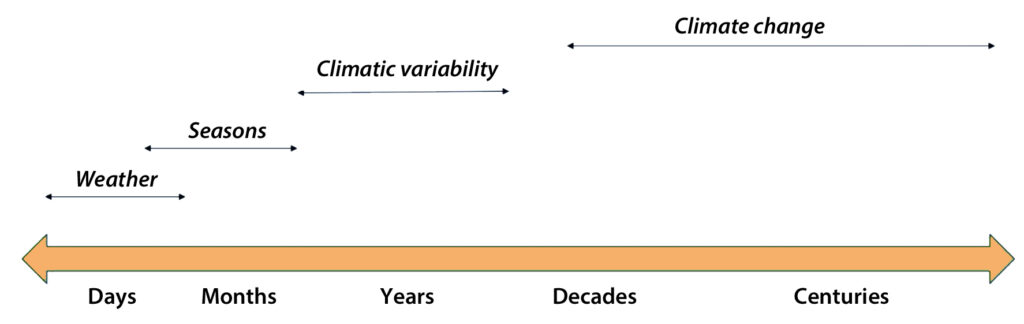
Weather refers to short-term (hours, days, weeks) atmospheric conditions at a particular place and time and is assessed through variables such as temperature, precipitation, humidity, cloudiness/sunshine, wind, and atmospheric pressure.
Seasons are recurring regular patterns of change throughout the year, typically of a few months duration, with different weather patterns. In temperate regions the latter are characterized by different daylight levels and temperature regimes (spring, summer, autumn and winter). In tropical and subtropical regions, seasons are often categorized as rainy (wet) and dry seasons.
Seasons thus represent the predictable, cyclical changes that occur over months within the context of a year, influenced by the Earth’s position relative to the Sun or by specific regional factors like monsoons.
Climate is the average of weather conditions over a long period, typically 30 years or more and is therefore representative for longer-term weather patterns and trends in a given region. Climate is assessed through averages and variations of the same primary weather variables over such period, and through more integrated concepts, such as potential evapotranspiration and growing period.
More info on Potential Evapotranspiration
More info on the Growing Period concept
Climates can be very different across the globe, such as the Mediterranean climate, characterized by hot, dry summers and mild, wet winters, or the tropical rainforest climate, known for high humidity and heavy rainfall year-round.
Climate classifications offer a synthesis of climatic conditions and allow to establish patterns of homogeneity, similarity or difference between different parts of the world.
More info on Climate Classifications
Climatic variability
Any climate is characterized by short-term (seasonal, annual or even decadal) deviations from average conditions. They are caused by natural phenomena, such as ocean-atmospheric interactions (e.g. El Niño and La Niña), volcanic eruptions, changes in solar radiations. Examples are a year of extreme drought or high rainfall, a particularly cold or unusually mild winter. Given its potential impact on agricultural production and food security, a good understanding of variability within given climatic zones is important.
More info on Assessing Climatic Variability
Climate change
When significant changes occur in the mean state of climate or the variability of its properties, we no longer refer to climate variability but to climate change. Climate change therefore refers to long-term shifts in the Earth’s climate over periods ranging from several decades to centuries, or even on a geological time scale. These changes may affect average temperatures, precipitation patterns, alterations in wind systems, extreme weather events, and sea-level rise, and may eventually lead to a new climatic baseline that affects human activities and the natural environment.
More info on Assessing Climate Change
In summary, weather and climate exist on a time-based continuum, with seasons and climatic variability serving as intermediaries and climate change marking the transition from the end of one climate state to the beginning of a new one. (Figure 4).