
Implementing Integrated Land Use Planning: A step-by-step guide for rural areas
PRACTITIONER’S GUIDE: STEP 2
PART 2
2.3. ACTIVITIES
The first task for the Coordinating Unit is to arrange a meeting with all stakeholders identified during this step. The objectives of this initial meeting are threefold:
1) To inform stakeholders about the land use problem, present the current thinking on how it might be addressed, and gather comments and concerns from all participants;
2) To understand the relative stake each stakeholder has in the proposed interventions and assess the likely impacts—positive or negative—on their livelihoods;
3) To explore potential synergies, partnerships, and opportunities for collaboration among stakeholders in support of the plan’s objectives.
Various tools can support the successful conduct of an introductory stakeholder meeting. One particularly useful method is the Venn diagram, which uses overlapping circles or ellipses to illustrate relationships between different stakeholder groups (see Box 8).
Box 8. Using the Venn Diagram in a Stakeholder Meeting (FAO, 2011b)
In stakeholder analysis, Venn diagrams can be applied using the following steps:
- Before the meeting, prepare paper circles in different sizes and colors.
- Ask participants to decide whether each stakeholder group should be represented by a small, medium, or large circle—depending on their relative stake or the extent to which they will be affected by the plan. Write the name of each stakeholder on their circle. Use distinct colors for individuals or groups likely to be negatively affected.
- Draw a large circle on the ground or on a flipchart to represent the community.
- Ask participants to place their stakeholder circles inside the community boundary (see Figure 10), in relation to one another, based on their degree of interaction with the proposed activity
• Separate circles = no contact
• Touching circles = exchange of information
• Small overlap = some support/partnership and shared interests
• Large overlap = strong collaboration and shared interests - Discuss and adjust the positions of the circles until consensus is reached.
- Use broken lines to indicate conflict, competition, or disagreement between stakeholders.
- Repeat the process with external stakeholders, placing their circles outside the community boundary.
An example of a Venn diagram is shown in Figure 13, which illustrates stakeholder relationships in a simple project introducing a livestock dipping post in a village.
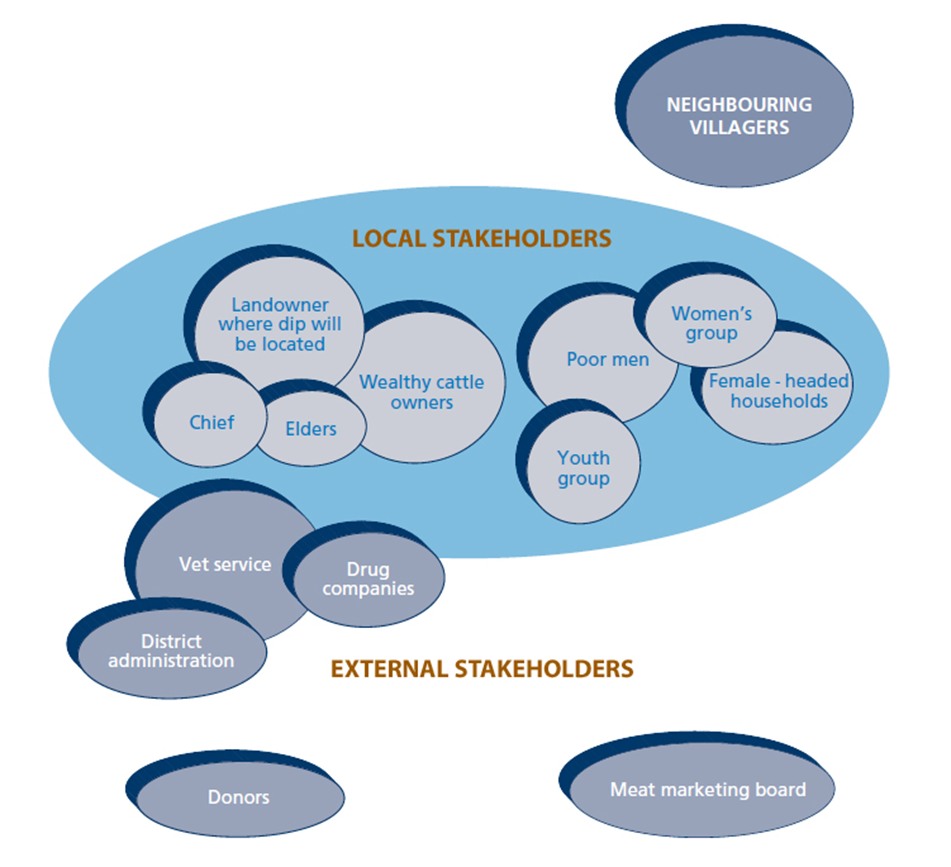
In addition to organizing the stakeholder meeting, the Coordinating Unit must also:
• Contact potential contributing agents to secure human, financial, and technical resources;
• Conduct a preliminary review of existing legislation and conventions relevant to the proposed land use change.
2.4. DELIVERABLES
The main deliverable from this step is a consolidated report documenting the findings of the Coordinating Unit’s initial stakeholder analysis. This document will serve as a foundation for the multi-disciplinary Task Force to be established in Step 3, and is therefore of critical importance. Accurate and comprehensive reporting will ensure that the Task Force gains a clear understanding of the characteristics and dynamics of the various stakeholder groups, allowing it to proceed effectively with further social studies in Step 4 and Step 5.
The report should include a synthesis of the following elements:
Stakeholder Analysis Outcome:
• Inventory of direct and indirect stakeholders
• Description of their activities and rights associated with land use
• Summary of their views and concerns about the proposed land use/management changes
• Assessment of their level of interest and capacity to influence plan implementation
Overview of the Legal and Social Context:
Summary of relevant legislation, social structures, and conventions related to land use issues
2.5. TOOLS
In addition to the stakeholder analysis method described in Box 8, the following tools are particularly useful:
- FPIC: Guidelines on Free, Prior and Informed Consent of Indigenous Peoples. These are especially relevant in areas where indigenous communities fully or partially occupy or use the land, ensuring their rights are respected before any intervention.
- DIMITRA: Dimitra Listener’s Clubs are groups of women, men, and young people—mixed or separate—who organize themselves to drive positive change in their communities. Often representing overlooked stakeholder groups in land use discussions, these clubs use collective action to voice their interests and concerns effectively.
- GLRD: The Gender and Land Rights Database provides information for 84 countries on issues such as customary law and practices, constitutional rights, women’s tenure rights under personal and labor laws, as well as inheritance and land legislation. It also details policy measures and legal mechanisms that either promote or hinder gender-equitable land tenure.
- IGETI: This tool highlights the role of a Territorial Facilitator in stakeholder analysis. Such facilitators help establish dialogue and build trust among stakeholders, especially in finding common ground for territorial discussions and encouraging the active participation of weaker groups.
- SEAGA: The Socio-Economic and Gender Analysis toolkit includes a ‘Stakeholders’ Priorities for Development Toolkit’, offering detailed methods to assess development priorities and challenges as perceived by men, women, and diverse socio-economic groups.
| CHECKLIST | |
| Step 2 Identify the people with an interest in the land use question | |
| Responsibility | Coordinating entity <=> Stakeholders |
| Key Questions | Who are the categories of people directly affected by a change in land use/management? |
| Who might become ‘winners’ and ‘losers’ from the proposed changes? | |
| Which institutions can mobilize human, financial, and technical resources to support implementation? | |
| Activities | Organize a meeting with all currently identified stakeholders. |
| Collect initial opinions from land users and conduct interviews with relevant governance levels, local authorities, and key informants, as preparation for detailed studies in Steps 4 and 5. | |
| Identify potential contributing agents to provide the required human, financial, and technical resources. | |
| Deliverables | Inventory of direct and indirect stakeholders, their activities, land use rights, views, and concerns regarding the proposed changes. |
| Overview of relevant legislation, social structures, and conventions linked to land use issues. | |
| Tools | DIMITRA, FPIC, GLRD, IGETI, SEAGA. |