

2.1.1.2. The Köppen-Geiger classification of climatic zones
The Köppen climate classification system, developed by Waldimir Köppen (1846-1940), categorizes climates based on annual and monthly averages of precipitation and temperature. First published in 1918, the system has been revised several times, notably by Köppen and Geiger (Köppen and Geiger, 1928). Despite its age, it remains the most widely used climate classification system today.
The Köppen system divides climates into five major types, designated by a capital letter:
A-climates: tropical moist climates
These climates have year-round temperatures above 18°C and abundant rainfall. Their typical extent is north and south of the equator between 15°- 25° latitude. Based on seasonal precipitation, A-climates are subdivided into Af (tropical wet), Am (tropical monsoon with a moderate dry season), Aw (tropical wet and dry with winter drought), and As (tropical wet and dry with summer drought).
B-climates: dry climates
Characterized by insufficient precipitation relative to plant water needs, these climates are generally found in (i) subtropical deserts (20°-30° latitude), (ii) continental mid-latitudes distant from moisture sources, and (iii) rain shadows of high mountains. Köppen subdivided B-climates into BS (semi-arid or steppe) and BW (arid or desert), with further distinctions possible on the basis of temperature and the dry season’s characteristics.
C-climates: moist climates with mild winters
These temperate climates have adequate precipitation and distinct seasonal variation, with winters that may be cold but not severe. They typically occur along eastern and western continental edges, between 20°-40° latitude. Subdivisions include Cw (dry winter season), Cs (dry summer season), and Cf (no pronounced dry season), with additional distinctions based on summer temperatures.
D-climates: moist climates with cold winters
Featuring warm to cool summers and cold winters with persistent snow cover, D-climates are found between 40°-70° latitude in large northern hemisphere landmasses. Similar to C-climates, they are further subdivided based on dry season timing and summer temperature.
E-climates: arctic climates
Characterized by year-round low temperatures, E-climates include polar tundra (ET) and ice sheets (EF), as well as high-altitude locations in mountain ranges.
Table 3 provides an overview of the Köppen-Geiger climate classes and their defining criteria.
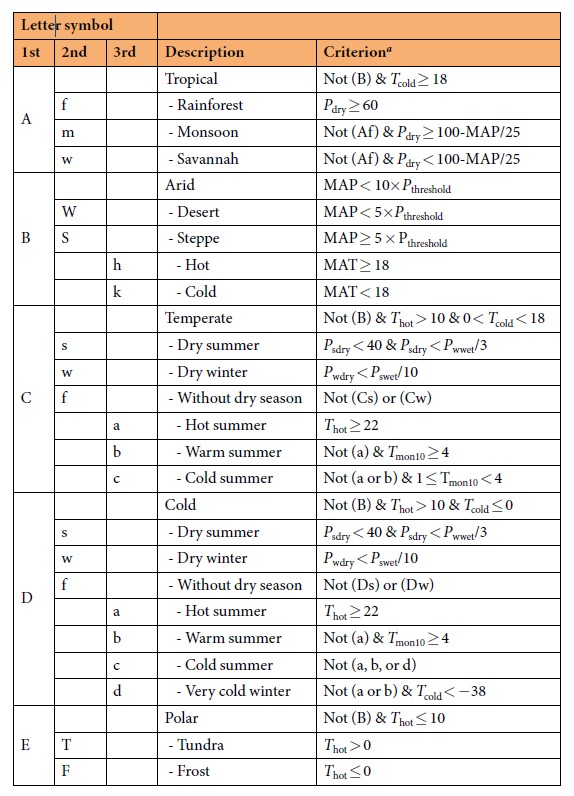
Variable definitions:
MAT = mean annual air temperature (°C);
Tcold = the air temperature of the coldest month (°C);
Thot = the air temperature of the warmest month (°C);
T mon10 = the number of months with air temperature > 10 °C (unitless);
MAP = mean annual precipitation (mm y−1);
Pdry = precipitation in the driest month (mm month−1);
Psdry = precipitation in the driest month in summer (mm month−1);
Pwdry = precipitation in the driest month in winter (mm month−1);
Pswet = precipitation in the wettest month in summer (mm month−1);
Pwwet = precipitation in the wettest month in winter (mm month−1);
Pthreshold = 2×MAT if > 70% of precipitation falls in winter,
Pthreshold = 2×MAT + 28 if > 70% of precipitation falls in summer, otherwise
Pthreshold = 2×MAT + 14. Summer (winter) is the six-month period that is warmer (colder) between April–September and October–March.
Reference:
Peel, M. C., Finlayson, B. L. & McMahon, T. A. Updated world map of the Köppen-Geiger climate classification. Hydrology and Earth. System Sciences 11, 1633–1644, (2007).
A Generalized Map of World Climates according to the Köppen-Geiger system is available for download here. Using the same criteria and an expanded dataset, it is possible to create more detailed maps of Köppen-Geiger climatic zones. Examples of such maps are found in studies of the Near East (Pub.77), Central Asia (Pub.94), and Iraq and Jordan (Pub.109).
