

2.1.5.4.1. Global Climate Models (GCMs)
Global Climate Models (GCMs) simulate the Earth’s climate system and predict how it might change under different future conditions, using mathematical equations to represent physical processes and the interactions between various climate system components.
Between the first (FAR) and the latest Assessment Report (AR6), GCMs have developed increasing complexity, higher resolution, and greater integration with Earth system components. As a result, they are now significantly more capable of projecting future climatic conditions under various socio-economic assumptions and assessing potential impacts and mitigation strategies.
FAR relied on relatively simple GCMs with low spatial resolution, which limited their ability to simulate regional climate features. These models also lacked detailed representations of oceans, land surfaces, and feedback mechanisms. Moreover, only a small number of models were available, each exhibiting considerable variability in their results.
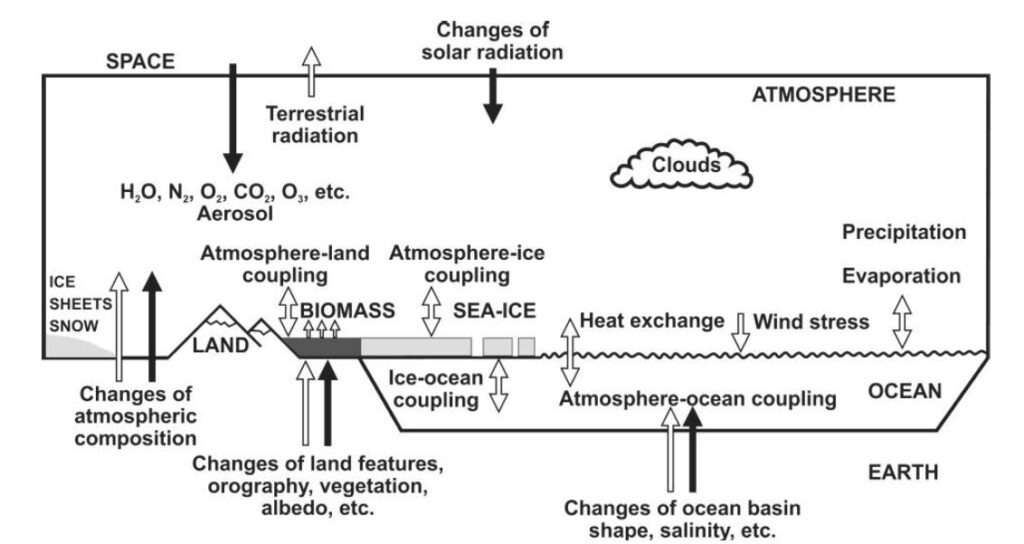
Since AR4, advanced Earth System Models (ESMs) have been employed, integrating the atmosphere, oceans, land, ice, and biogeochemical cycles. These models include sophisticated feedback mechanisms, such as cloud dynamics, vegetation and carbon cycle interactions, and aerosol effects (Fig. 7).
AR6 provides an extensive analysis of climate change impacts, adaptation, and mitigation options, and features scenarios that integrate socio-economic pathways (SSPs) with quantified emission projections (RCPs). Moreover, through its participation in the Coupled Model Intercomparison Project Phase 6 (CMIP6)—which standardizes model simulations and facilitates inter-model comparisons—AR6 is better able to capture uncertainties and variabilities in climate projections.
More info on the Coupled Model Intercomparison Project Phase 6 (CMIP6)