
Implementing Integrated Land Use Planning: A step-by-step guide for rural areas
PRACTITIONER’S GUIDE: STEP 9
PART 1
Step 9
MONITOR, EVALUATE AND REVISE THE LAND USE PLAN
The lifespan of a land use plan is inherently fairly rigid—implementation cannot be excessively prolonged or rushed. Additionally, external conditions may change either suddenly (e.g., a severe drought, a destructive flood, or a shift in government policy) or gradually (e.g., declining stakeholder interest, fluctuations in commodity prices, or the emergence of new markets for local products). These changes may impact the initial assumptions that guided the plan’s design. Therefore, monitoring whether implementation remains on track is an essential component of land use planning.
9.1. MONITORING AND EVALUATION
Monitoring provides the Task Force and key stakeholders with regular feedback and early warnings about progress—or lack thereof—toward the intended results. To be effective, monitoring must be conducted throughout the implementation phase. It typically involves:
• Physical inspections at key sites,
• Discussions with officials and land users, and
• Data analysis to assess progress.
A monitoring timetable and checklist can help ensure a structured approach.
However, while closely tracking implementation details is necessary, there is a risk of mistaking minor process glitches for serious setbacks. To avoid this, routine monitoring should be complemented by a broader, more reflective evaluation that assesses the plan’s overall performance. This type of evaluation seeks to answer key questions, such as:
• Is the plan achieving its intended outcomes?
• Is the plan adequately funded at this stage?
• Are any project outputs having a negative impact and, if so, should they be modified or discontinued?
• Does the agreed-upon plan still reflect stakeholders’ objectives?
• Are there previously unrecognized opportunities or obstacles?
• Should additional stakeholders be included?
Evaluation is a systematic and objective assessment of a project, program, or policy—its design, implementation, and results. Evaluating land use plan implementation can also identify gaps or overlaps in institutional mandates, ultimately contributing to improvements in policy and legal frameworks.
While evaluation may seem like an additional burden, it is also an opportunity to:
• Extract lessons from experience,
• Maintain stakeholder consensus through consultation and feedback, and
• Keep the planning process dynamic and responsive to changing conditions.
9.2. EVALUATING PLAN CONFORMANCE AND PERFORMANCE
Two key concepts guide the evaluation of plan implementation: conformance and performance.
Conformance: the traditional evaluation approach
The conformance approach considers a plan successfully implemented if its proposed policies are carried out and the expected outcomes materialize. For example, if a designated area is successfully cleared of rocks and stones for crop cultivation, as specified in the plan, the implementation is deemed successful.
Conformance evaluation typically relies on quantitative indicators, which can be monitored using tools such as remote sensing and GIS.
Performance: an alternative perspective
The performance approach measures success by assessing the plan’s influence on decision-making, even if actual decisions deviate from its proposed policies. This counterintuitive view was originally formulated for strategic spatial plans, which aim to coordinate diverse projects and actions across multiple actors.
According to Faludi (2000): “Plans must be evaluated, not primarily in the light of their material outcomes, but for how they improve decision-makers’ understanding of present and future problems. (…) Plans perform their role if and when they help decision-makers make sense of their situations, and so they need to be evaluated in this light.”
Performance evaluation typically employs qualitative methods, as it focuses on policy impacts rather than physical implementation (De Montis, 2016).
Integrating conformance and performance evaluations
Conformance and performance are not mutually exclusive—a plan can exhibit high or low conformance and still be considered either successful or unsuccessful in terms of performance (Hossu et al., 2021).
Combining both approaches provides a more comprehensive understanding of a plan’s successes, challenges, and overall effectiveness.
A review of planning literature by Hossu et al. (2021) identified four key factors that significantly influence plan implementation:
• Plan quality – clarity, feasibility, and coherence of the plan’s objectives.
• Institutional capacity – the ability of the planning agency to implement and oversee the plan effectively.
• Local political support – backing from government authorities and policymakers.
• Stakeholder participation – engagement of affected communities, private sector actors, and other key stakeholders.
Table 13 outlines criteria that have been used in various contexts to assess these factors.
Table 13. Factors and criteria for evaluation (source: Hossu et al., 2021)
| Factor to be evaluated | Criteria for evaluation |
| Plan quality | • Clarity of the goals • Robustness of the factual basis • Adequacy of policies • Quality of public participation • Clear implementation and monitoring guidance • Integration with other plans and policies • Comprehensibility of plans |
| Capacity of the planning agency | • Number of staff with specific planning responsibilities • Number of planning staff per capita • Staff experience • Agency commitment to implementation Resources available for implementation |
| Local political support | • Adequacy of financial resources for plan implementation • Promotion of collaboration |
| Stakeholder participation | • Stakeholder types or group members • Degree of stakeholder participation • Types of participation techniques involved in the process of plan-making • Written comments compiled during the planning process |
9.3. PARTICIPATORY MONITORING AND EVALUATION
The positive impact of stakeholder participation on plan implementation is well recognized. While traditional project evaluation is typically conducted by independent professionals, maintaining continuous stakeholder involvement requires a parallel track of participatory monitoring and evaluation (PM&E).
PM&E differs significantly from conventional evaluation, which generally relies on external experts who assess performance using pre-set indicators and standardized procedures.
In contrast, PM&E emphasizes learning, flexibility, and stakeholder-driven assessment (Table 14).
Table 14. Differences between participatory and conventional monitoring & evaluation (USAID, 1996)
| Participatory M&E | Conventional M&E |
| Broad stakeholder participation: a diverse range of stakeholders actively engages in the process. | Limited stakeholder involvement: evaluation is typically conducted by external experts, with little to no participation from those affected. |
| Focus on learning: emphasis on identifying lessons learned to improve program implementation, in addition to assessing whether targets were met. | Focus on accountability: primary objective is to determine whether goals were achieved, often for reporting purposes. |
| Flexible design: evaluation design is developed through a participatory process, allowing stakeholders to define key questions and methods. | Fixed design: evaluation follows a predetermined structure, usually defined by external evaluators. |
| Rapid appraisal methods (e.g., focus groups, participatory mapping, and community discussions) are commonly used. | Formal methods (e.g., structured surveys and standardized performance metrics) are applied. |
| Outsiders serve as facilitators: external experts provide guidance, mentoring, and technical support, but stakeholders conduct the evaluation. | Outsiders serve as evaluators: external professionals lead the evaluation process. |
| Stakeholder-oriented: the process is primarily designed to meet the information needs of local participants and program stakeholders. | Donor/funder-oriented: the evaluation is mainly conducted to satisfy the funding agency’s reporting requirements. |
By integrating participatory methods, PM&E not only enhances local ownership of the planning process but also builds capacity, ensuring that stakeholders are actively engaged in both implementation and continuous improvement.
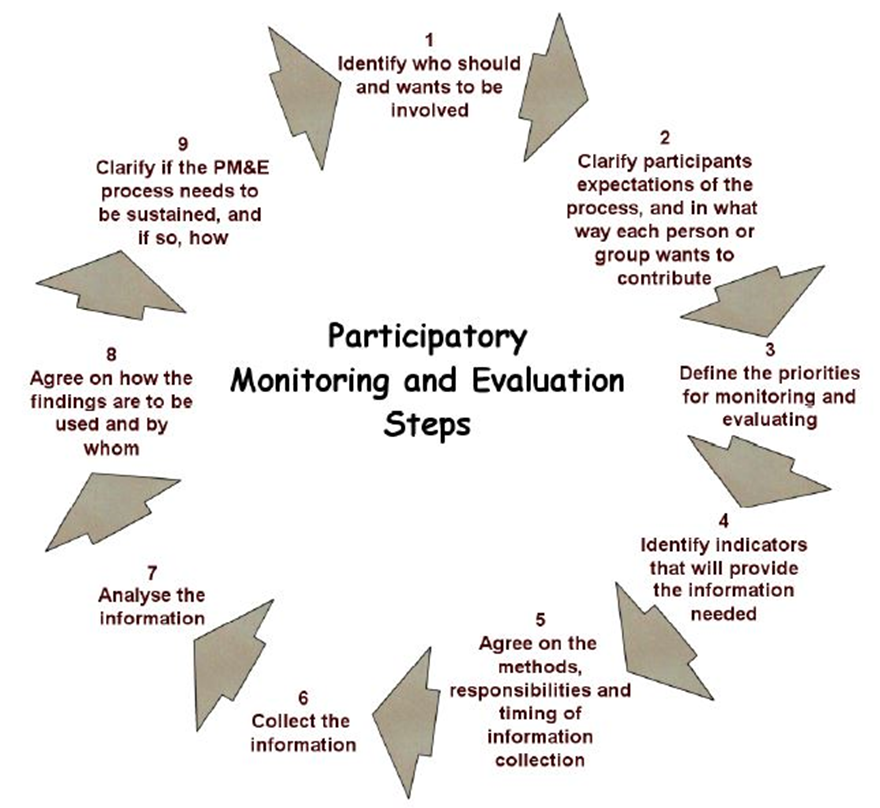
The typical steps involved in a PM&E process are summarized in Figure 33.
9.4. PLAN REVISION
There are many reasons why plan implementation may not proceed as intended. Common examples include (FAO, 1993):
- False assumptions – For instance, low crop yields might have been attributed to water shortages, while the real issue was soil fertility constraints.
- Economic changes – A drastic drop in commodity prices can affect the feasibility of certain land use strategies.
- Logistical failures – Essential inputs (e.g., fertilizers) may not reach farmers on time or in sufficient quantity.
- Communication and participation issues – Farmers may not adopt the recommended crops due to a lack of engagement or understanding.
Each of these issues may be minor and easily corrected or critical enough to threaten the project, depending on the context.
Whenever delivery problems arise, the best approach is to discuss them with those who can take corrective action. Minor adjustments can often be handled at the level of implementing agents, but major revisions requiring substantial changes must be referred back to the decision-makers who initiated the project.
Land use planning as an iterative process
Land use planning is inherently iterative, meaning revisiting earlier steps is sometimes necessary to identify where things went wrong. A useful approach is to pinpoint the problem’s origin within the 9-step planning framework.
As Figure 11 illustrates, a successful planning cycle should start with an accurate problem analysis (Step 1). If this step was flawed, the entire process may need to be redone from scratch. However, mistakes at any stage can lead to costly setbacks that may only become apparent during implementation.
The further back in the planning cycle the issue originates, the harder it becomes to correct course. To minimize the risk of failure or abandonment, it is essential to follow a logical sequence:
- Identify stakeholders (Step 2)
- Form a Task Force (Step 3)
- Conduct research on land, land use, and land users (Step 4 and Step 5)
- Negotiate land use options (Step 6)
- Prepare and finalize the plan (Step 7)
By maintaining a structured and flexible approach, planners can anticipate challenges, adapt to changing conditions, and ensure more effective plan implementation.