
Implementing Integrated Land Use Planning: A step-by-step guide for rural areas
PRACTITIONER’S GUIDE: STEP 6
PART 2
6.1.2. Conducting the negotiations
To launch the negotiation process, it is advisable to organize a kick-off meeting at the appropriate level—national, district, or local—that brings together as many stakeholders as possible. During this meeting, the findings of the assessments and the proposed responses are summarized and presented, preferably by local members of the community who actively participated in the Land Use Planning Task Force. Such town meetings (or national workshops) establish a shared platform where broad input can be gathered, potentially forming the foundation for a vision statement.
To ensure strong participation, these meetings must be announced well in advance through the most effective communication channels, which may vary by country. This can include a combination of local press, radio, television, and internet.
6.1.2.1. Setting the ground rules to guarantee a fair negotiation process
Ground rules are essential to define roles, responsibilities, competencies, and the objectives of the negotiation. They also establish mechanisms to ensure inclusive participation and specify rules for communication.
Key areas requiring agreement include:
- The type of negotiation process (direct, or involving a third party)
- The status of the third party (impartial or partial; insider or outsider)
- The meeting format (individual or joint sessions)
- The dialogue process (who may speak, how, and in what style)
- The decision-making process (agreement format and mechanisms for enforcement)
(FAO, 2005)
Ground rules help counter persistent asymmetries in the capacities and bargaining power of different actors. Weaker groups risk significant losses if negotiations are dominated by powerful stakeholders who may act unilaterally or refuse to engage.
To mitigate these risks, it is critical to plan for grievance and redress mechanisms, ensuring that any agreement reached is consensual or majority-based, and that any loss of rights is fairly compensated.
6.1.2.2. Facilitating consensus building
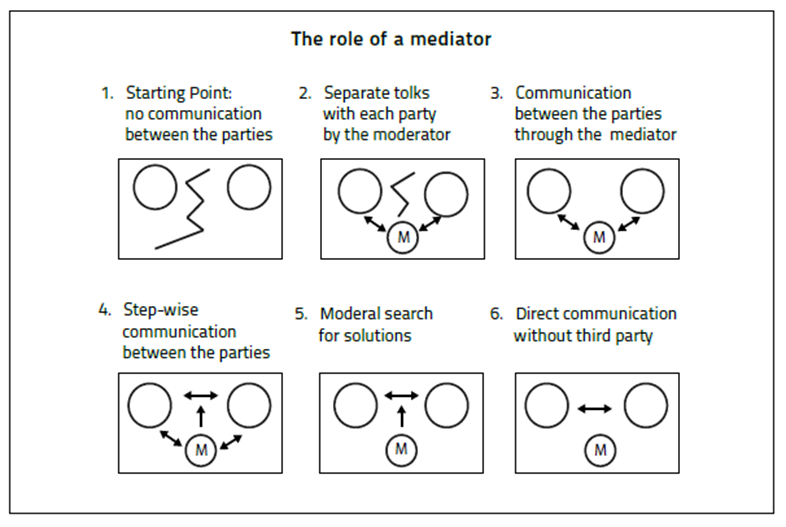
In many cases—especially when numerous stakeholders are involved or where tensions may escalate—there is a need for an ‘honest broker’, a neutral third party (facilitator or mediator) to guide the negotiations and keep participants focused on the agenda.
Mediation is a process of assisted negotiation. The mediator ensures that all stakeholders agree on the process and logistics and helps participants establish appropriate ground rules (see section 6.1.2.1). These rules must be agreed upon at the outset and applied consistently throughout the negotiation.
The mediator’s role and responsibilities are determined by the parties themselves and may vary according to context, local norms, values, and the issues at stake. In some situations, mediators may play a proactive role, helping bring disputing parties to the table and proposing potential solutions, such as compensatory measures, subsidies, or other incentives (FAO, 2005).
For mediation to be successful, the facilitator’s involvement must be adaptive, evolving over the course of the negotiations and gradually phasing out as consensus builds (Figure 31).
6.1.2.3. Organizing the negotiations
For land use interventions at the local (municipality/district) level, it is recommended to prepare negotiations through working groups (FAO, 2016). Box 25 summarizes key points on the function and organization of such groups.
Box 25. The role of working groups (source: FAO, 2016)
There are several reasons for dividing stakeholders into working groups.
First, smaller groups are easier to manage in terms of logistics and facilitation. A group size of 7 to 15 participants is generally considered optimal. Groups smaller than seven may lack diversity, while groups larger than fifteen become unwieldy.
It is possible for a stakeholder to participate in more than one group; in fact, it is essential that the key stakeholder, such as the district or municipal administration, be represented in all working groups.
Second, since each group operates independently, multiple small groups can generate a wider variety of ideas, helping to avoid groupthink—the uncritical acceptance of prevailing views. Smaller groups also empower weaker stakeholders who may be reluctant to voice opinions in larger meetings.
Finally, organizing working groups around specific land use themes or spatial zones ensures a focused discussion among participants with a shared interest, as opposed to a general discussion among diverse and potentially divergent groups.
When forming working groups, two important principles apply:
- Theme-based or spatial organization: groups should be organized around a land use theme or spatial zone, not by institution, profession, or discipline. Land use issues are cross-cutting and rarely conform to bureaucratic categories, instead affecting and involving multiple sectors and governance levels. Avoiding institutional groupings also reduces groupthink and encourages idea confrontation and synthesis.
- Broad stakeholder representation: group membership should reflect the full spectrum of stakeholder interests, including those who:
• Possess expertise or information about the land use theme or zone;
• Have authority or responsibility over it;
• Are affected by or have an impact on it.
This diversity should encompass public and private sectors, community groups, and the general public. Such inclusivity is critical for building meaningful consensus and ensuring participation in decision-making.
The overall objective of each working group is to discuss, negotiate, and agree on a scenario that best meets the shared needs of stakeholders for the specific spatial zone or land use theme. These results are then consolidated into a vision statement.
As with previous activities, negotiations should be conducted as an iterative, organic process rather than a rigid series of steps. The success of this process heavily depends on the proficiency of the mediator(s) involved.
Once consensus is reached within each working group, their conclusions must be combined into an overarching vision for the entire territory. This is achieved in a plenary workshop, where each group presents the results of its deliberations. The workshop aims to:
• Sensitize stakeholders to the various group visions;
• Harmonize and integrate these visions;
• Identify and resolve conflicts between groups;
• Formulate a unified consensus reflecting all inputs.
The role of mediation is particularly critical at this stage, especially if negotiations reach a stalemate or if parties require external assistance. Mediation may be essential when (FAO, 2012a):
• Emotions run high, hindering compromise;
• Communication between parties breaks down;
• Serious disputes arise over facts or information;
• A significant power imbalance persists, despite efforts to address it through ground rules.
Perseverance is essential in challenging negotiations. If all mediation efforts fail and the dispute proceeds to court, the opportunity for collaborative resolution is lost. Stakeholders may become disillusioned with the process, the conflict will be prolonged, and hostilities may deepen.
Once a resolution is reached, it should be documented in writing and signed by all parties.
6.1.2.4. Outcome of the process
The consensus reached in the plenary workshop is referred to as the Territorial Pact.
Following the approach of Biancalani et al. (2004), the Territorial Pact should include the following core elements:
• An opening narrative that captures the identity of the entire municipality or district, weaving together the key themes, priorities, and values expressed by all working groups.
• A consensus land use plan that identifies and describes the physical, social, ecological, political, and economic dimensions recognized as important by stakeholders. This plan should reference the analytical work conducted during Step 5 and clearly outline the agreed development options for each spatial zone.
• A synthesis and harmonization of the working groups’ visions of the future, reflecting the collective aspirations of all inhabitants for the municipality or district.
The significance of this kind of conclusion to the negotiation process lies not only in the content of the pledged commitments, but even more in the social legitimacy of the decision—arising from its joint formulation and ownership by the stakeholders.
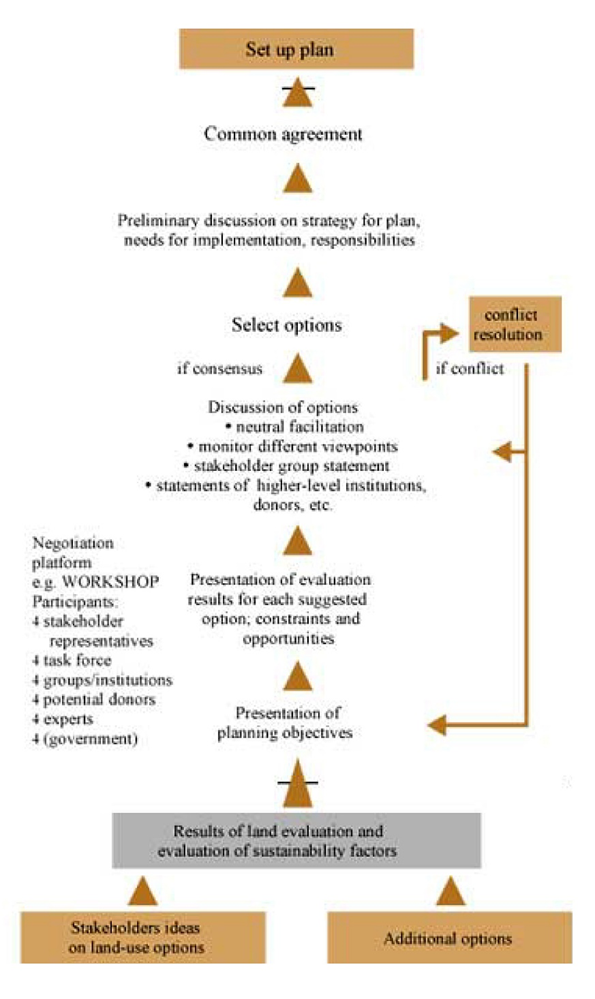
Figure 32 provides an overview of the entire negotiation process, from stakeholder engagement to the formalization of the Territorial Pact.
The next step in the process (→ Step 7) is to translate these shared aspirations into a concrete action plan, moving from vision to implementation