
Implementing Integrated Land Use Planning: A step-by-step guide for rural areas
PRACTITIONER’S GUIDE: STEP 5
PART 5
5.1.4. Environmental impact
Physical land suitability evaluation already includes the explicit notion that land use must be sustainable. Therefore, any use that degrades the land or water resource base on a continuing basis must be classified as not suitable.
However, an analysis of environmental impact goes beyond this implication. It requires that the likely positive or negative effects on the land—and, by extension, the affected communities—are anticipated and explicitly documented for each alternative use under consideration.
From a footnote in land resource studies 30 years ago, the impact of land use on the environment has evolved into one of the hottest topics in land use planning. Table 7 illustrates the level of environmental ambition embedded in the European Common Agricultural Policy (CAP).
Table 7 . Current major goals and policy priorities of the environmentally sustainable CAP
| Goal | Priorities for policy development |
| Tackling climate change | • Reducing greenhouse gas emissions by promoting improved livestock management and breeding, and investing in manure storage and treatment • Increasing carbon sequestration and storage through measures such as soil protection and forest restoration • Supporting farmers in adapting to climate change through investments and advice on new methods and technologies |
| Protecting natural resources and biodiversity | • Safeguarding the quantity and quality of agricultural water use by establishing buffer strips along watercourses, promoting efficient irrigation systems, and enhancing enforcement in nitrate vulnerable zones • Setting mandatory standards for minimum soil cover and encouraging practices that limit soil erosion and maintain soil organic matter • Protecting air quality by reducing ammonia emissions, restricting residue burning, and preventing pesticide spraying in windy conditions |
| Encouraging low-input agriculture | • Promoting organic farming • Supporting responsible pesticide and fertilizer use, and encouraging environmentally friendly management practices, alternative methods, and new technologies • Reducing antibiotic use by investing in measures that improve animal health and welfare |
Environmental impact assessment (EIA) is a procedure that ensures the environmental implications of decisions are considered before those decisions are made. In principle, all plans, programmes, and projects—regardless of their goals—that are likely to have significant environmental effects must undergo an environmental assessment prior to approval.
A mandatory feature of EIA is public consultation. While these key principles are enshrined in law in most countries, actual adherence is far less common.
A primary concern regarding the environmental consequences of a land development project is that they may extend beyond the planning area. For example, continued groundwater extraction beyond natural recharge capacity to irrigate cash crops may threaten not only the livelihoods of farmers but also the water supply and quality of entire communities far beyond the project area. Table 8 provides examples of environmental effects that must be considered when planning major land use interventions.
Table 8. Examples of environmental issues to be considered in an EIA (adapted from FAO, 1993)
| Theme | Major environmental risks |
| Soil and water resources | • Risk of soil erosion, landslides, and sedimentation • Security of water supply and quality within and beyond the planning area |
| Pasture and forest resources | • Degradation of rangelands • Clearance or degradation of forests |
| Biodiversity | • Alteration of the structure and composition of forests, grasslands, and wetlands • Decline of areas critical for animal and plant communities and germplasm conservation • Negative side effects of terrestrial developments on wetland ecosystems |
| Scenic and recreational value for tourism | • Pollution of tourism hotspots due to over-exploitation • Lack of regulation of leisure industries, causing competition with other land uses |
The EIA process follows a systematic and structured sequence of steps involving the analysis of likely consequences of a proposed development. This includes assessing baseline environmental conditions and predicting impacts of alternative land uses during development, operation, and eventual change or closure.
A recommended framework for preparing a structured EIA report, consisting of seven main steps, is shown in Figure 26. The Irish Environmental Protection Agency (2022) has published detailed guidelines on this topic.
Figure 26 underscores the importance of consultation, which is a common thread throughout the entire EIA process. To support the public’s right to clear information, EIA reports must be understandable to a non-technical audience, particularly in presenting the baseline assessments and the evaluated alternatives.
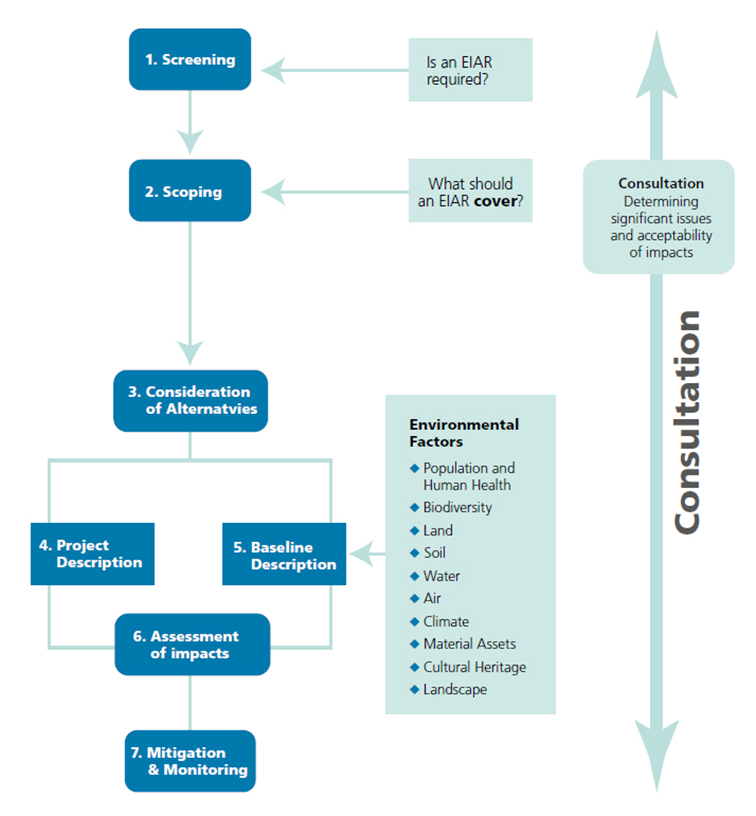
Additional recommendations for EIA reports include:
- EIA reports must focus on effects that are both likely and significant. To prevent ambiguous terminology that could lead to varying interpretations, a standard classification system is required for terms related to quality, significance, extent, and context of environmental effects (Table 9).
- The description of environmental effects must be accurate, credible, and provide a clear documentary trail of the analysis supporting the EIA’s conclusions.
- With growing awareness of climate change, EIAs should address both the impact of the proposed land use change on climate and the vulnerability of the project to climate change.
Table 9. Standardized terminology for the description of environmental effects
(Environmental Protection Agency, 2022)
| Attribute | Kind | Description |
| Quality of effects | Positive | A change which improves the quality of the environment (for example, by increasing species diversity, or improving the reproductive capacity of an ecosystem, or by removing nuisances or improving amenities) |
| Neutral | No effects or effects that are imperceptible, within normal bounds of variation or within the margin of forecasting error. | |
| Negative/adverse | A change which reduces the quality of the environment (e.g. lessening specieis diversity or diminishing the reproductive capacity of an ecosystem, or damaging health or property or by causing nuisance) | |
| Significance of effects | Imperceptible | An effect capable of measurement but without significant consequences |
| Not significant | An effect which causes noticeable changes in the character of the environment but without significant consequences | |
| Slightly significant | An effect which causes noticeable changes in the character of the environment without affecting its sensitivities | |
| Moderately significant | An effect that alters the character of the environment in a manner that is consistent with existing and emerging baseline trends | |
| Significant | An effect which, by its character, magnitude, duration or intensity, alters a sensitive aspect of the environment | |
| Very significant | An effect which, by its character, magnitude, duration or intensity, significantly alters most of a sensitive aspect of the environment | |
| Profound | An effect which obliterates sensitive characteristics | |
| Extent and context of effects | Extent | The size of the area, the number of sites and the proportion of a population affected by an effect |
| Context | The degree to which the effect, its magnitude, duration or frequency conforms or contrasts with baseline conditions |