
Implementing Integrated Land Use Planning: A step-by-step guide for rural areas
PRACTITIONER’S GUIDE: STEP 5
PART 3
5.1.2. Sustainable land management assessments
Land suitability assessments, as carried out by land resource experts, are useful for predicting what kind of crops or generic land utilization types will best fit the biophysical potential of specific land units. They will also, in line with the Framework’s guiding principles, take into consideration issues of sustainable use, but without going into specifics.
However, under conditions of major change in land use, a different kind of methodological approach is required—one that focuses on determining what specific management practices will be needed to prevent land degradation and declining productivity (FAO, 2013; Liniger et al., 2013; Petri et al., 2016). Such an approach requires the involvement of actual land users and therefore needs to be participatory at all levels of governance.
Examples of how assessments for sustainable land management can be undertaken are provided in Box 17 (national/district levels) and Box 18 (local level). These assessments move beyond identifying suitable land use types; they aim to develop practical strategies that promote the long-term sustainability of land resources. This involves analyzing site-specific risks, evaluating existing land use practices, and identifying targeted interventions that are both environmentally sustainable and socio-economically viable.
Active engagement of stakeholders ensures ownership, encourages the adoption of recommended practices, and enhances the effectiveness of land management planning and implementation.
Box 17. Land management assessment at national and district level
The LADA-WOCAT_QM evaluation tool is recommended for mapping land degradation and sustainable land management at national and district levels. It uses the QM questionnaire, which records, for each land use system (LUS), its current extent, as well as changes in area extent and production intensity over the past 10 years.
On this basis, a detailed Driver–Pressure–State–Impact–Response (DPSIR) evaluation is carried out for each land use system (see Step 1 and Annex 1). The following factors are considered:
- the major types of land degradation currently present under each land use system;
- the current extent of the identified degradation types;
- the degree of land degradation at present;
- the rate of degradation over the past 10 years;
- the direct causes (pressures) of land degradation;
- the indirect causes (drivers) of land degradation;
- the estimated impact on ecosystem services for each degradation type.
It is recommended that the questionnaire be completed by a team of land degradation and conservation specialists with diverse backgrounds and experiences, working in close cooperation with land users and extension officers.
A simplified example is provided in Figure 22.
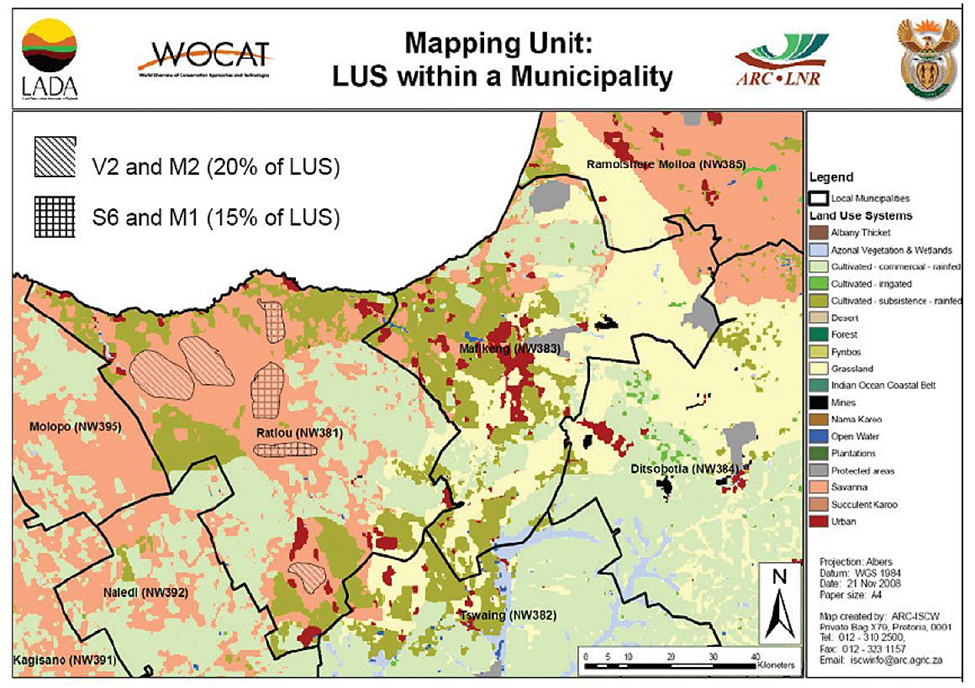
Land Use System: Livestock grazing in savanna, Ratlou Municipality, South Africa
LUS area trend: 2 (major increase) LUS intensity trend: 1 (moderate increase)
DPSIR indicators:
• Driver: Poverty, population pressure, tenure insecurity, lack of government support
• Pressure: Increased livestock numbers; some grassland fires
• Status: Moderate aridification and compaction; moderate increase in biodiversity loss
• Impact: Strong decline in livestock productivity; moderate water scarcity
• Response: Reseeding of perennial grasses; change from open to controlled grazing; dams
• Comment: Degradation more pronounced in communal grazing areas
The map illustrates the various conservation measures and their combinations or overlaps (shaded areas) within the savanna LUS in Ratlou Municipality (South Africa). In this case, 20% of the savanna LUS is covered by a combination of V2 (reseeding of perennial grasses) and M2 (change from open to controlled grazing), while another 15% is covered by S6 (dams/pans) and M1 (change of land use type).
For details on the methodology, see Liniger et al. (2013).
Box 18. Land management assessment at local level
The assessment follows the LADA_LOC methodological approach, which provides a toolkit for evaluating land degradation processes, their causes and impacts at the local level, in collaboration with local stakeholders and communities. In addition, the approach assesses the extent to which land resources (soil, vegetation, water) and landscapes/ecosystems are—or can be—conserved and/or improved through sustainable land management (SLM) practices.
Although the methodology involves an integrated land resources assessment, it provides separate protocols for evaluating the status, trends, and current SLM practices related to vegetation, soil, and water resources. The findings from these assessments are brought together and analyzed by a multi-disciplinary team for the various land use systems or types. These results are then integrated with insights from a livelihoods assessment, conducted across a range of land users or households selected through wealth ranking, along with data from focus group discussions and interviews with key informants.
For details on the methodology, refer to Bunning et al. (2016a and 2016b).
Within the LADA_LOC approach, SLM expert teams are encouraged to use the WOCAT questionnaires developed by the World Overview of Conservation Approaches and Technologies (WOCAT) (www.wocat.net) to evaluate a wide range of sustainable land management technologies (QT) and associated SLM approaches (QA).
WOCAT aims to assess, document, and share proven land management practices in order to scale up their use. All forms of sustainable land management are considered—whether traditional or indigenous, introduced through projects or programmes, adopted or adapted by land users, or recent innovations.
Two core questionnaires were developed:
• The Core Questionnaire on SLM Technologies (QT) describes and evaluates land management practices by addressing the following questions:
—What are the specifications of the technology?
—What are the inputs and costs?
—Where is it used (natural and human environment)?
—What impact does it have?
• The Core Questionnaire on SLM Approaches (QA) focuses on how SLM implementation was achieved (including capacity building, decision-making, technical and material support, changes in legal frameworks and policies) and who was involved (all stakeholders and their respective roles).