Implementing Integrated Land Use Planning: A step-by-step guide for rural areas INTRODUCTORY GUIDE: CHAPTER 2. OVERVIEW OF THE LAND USE PLANNING PROCESS
CHAPTER 2. OVERVIEW OF THE LAND USE PLANNING PROCESS
Every land use planning project is unique, with objectives and local conditions varying widely. As a result, no single, standardized approach can be applied to every case. Instead, each planning effort must be tailored to the specific context of the land use change being considered.
While there is no universal recipe, experience has shown that following a structured sequence of nine steps—each representing key activities and outputs—significantly improves the effectiveness of land use planning. This sequence applies across different scales, but its implementation will depend on the nature of the land use challenge, the decision-making level(s) involved, and the resources available.
These nine steps are outlined in Section 2.1, with detailed descriptions provided in Section 2.2. Additional guidance on applying each step can be found in Part 2, Practitioner’s Guide.
2.1. THE NINE-STEP APPROACH
Step 1. Initiate the land use planning process
Tasks: Identify the planning area, key issues, affected stakeholders, planning goals, and the overall approach.
Insight: Step 1 lays the foundation for the entire land use planning process—a phase often underestimated in its importance. This step requires careful conceptualization of the planning exercise from the outset (“planning the planning”). By clearly defining objectives, required resources, and potential challenges early on, it helps prevent misunderstandings and ensures a more effective and well-structured planning process.
Step 2. Identify the people with an interest in the land use question
Tasks: Identify all relevant stakeholders at the appropriate planning levels. Assess their characteristics, concerns, and potential benefits or losses resulting from land use changes, with particular attention to land tenure issues.
Insight: Step 2 is crucial for recognizing both direct and indirect stakeholders and understanding who stands to gain or lose from proposed changes. Careful implementation of this step ensures that no relevant groups are overlooked, fostering a more inclusive and equitable planning process.
Tasks: Assemble a team with the necessary technical expertise and stakeholder representation. Define their terms of reference, ensure access to relevant information, and clearly communicate their roles, responsibilities, and decision-making authority.
Insight: Step 3 ensures that the planning process is guided by the appropriate expertise and that key stakeholders are fairly represented. This team will manage or oversee the necessary studies outlined in the following steps, ensuring that the complexity of the land use issue is properly addressed.
Tasks: Describe the key characteristics of different land areas, land uses, and user groups. Compile relevant data using methods suited to the specific planning level.
Insight: Step 4 marks the initial phase of characterizing the planning area. It aims to develop a clear understanding of the distinct features of various land tracts, existing land uses, and the stakeholders involved, forming a foundation for informed decision-making in later steps.
Step 5. Assess biophysical potential and environmental, economic and social impacts
Tasks: Evaluate the environmental, economic, and social impacts of each physically suitable land-use option. Assess potential consequences—both positive and negative—for land users and the broader community. Consider alternative courses of action.
Insight: Step 5 represents the second phase of planning area characterization, focusing on the potential outcomes of proposed land use or management changes. This assessment goes beyond biophysically suitable areas to evaluate broader impacts, ensuring that both direct and indirect consequences on the environment, economy, and affected communities are carefully considered.
Step 6. Negotiate suitable and acceptable land use options
Tasks: Facilitate public and executive discussions on viable land use options and their consequences. Based on these discussions and prior assessments, determine which land use or management changes should be implemented or pursued.
Insight: Step 6 highlights the importance of inclusive stakeholder participation in shaping and refining the land use or management plan. Effective communication and negotiation strategies are essential to ensure that proposed changes are both practical and widely accepted.
Tasks: Allocate or recommend selected land uses for designated areas. Develop plans for appropriate land management, implementation strategies, and necessary improvements. Establish policy guidelines, draft a budget, and prepare any required legislation. Engage decision-makers, sectoral agencies, and land users in the process.
Insight: Step 7 ensures that all critical aspects of land use planning are addressed, including thorough documentation, logistical preparations, realistic timelines, budget considerations, and alignment with existing regulations. Since implementation varies widely based on specific objectives and local conditions, these guidelines do not attempt to list every possible activity but provide a framework for effective planning.
Tasks: Put the plan into action, either as part of the planning process or as a separate development project. The planning team should collaborate closely with implementing agencies to ensure successful execution.
Insight: Step 8 underscores the importance of adhering to best practices to ensure that commitments made in the land use plan are fulfilled and that land users remain actively engaged. While even the most well-crafted plans cannot predict every scenario, it is important to be flexible and adjust the plan as needed in response to on-the-ground realities.
Step 9. Monitor, evaluate and revise the land use plan
Tasks: Track the progress of the plan toward its goals and make modifications or revisions based on lessons learned during implementation.
Insight: Step 9 focuses on the key actions required to monitor plan implementation and revise it as needed. While the revision process can be challenging, especially after significant effort is invested in developing and implementing the plan, it is often necessary to preserve the integrity of the planning process. However, revision does not mean starting over. If the original plan is well-grounded, revisions typically involve only minor adjustments—such as changes to timelines, budgets, or implementing agents—rather than a complete overhaul.
Flexibility is essential when applying this stepwise approach to make the most of local circumstances. The key is to understand the purpose of each step, allowing activities and procedures to be adapted to specific goals. In some cases, certain steps may even be omitted, depending on the situation.
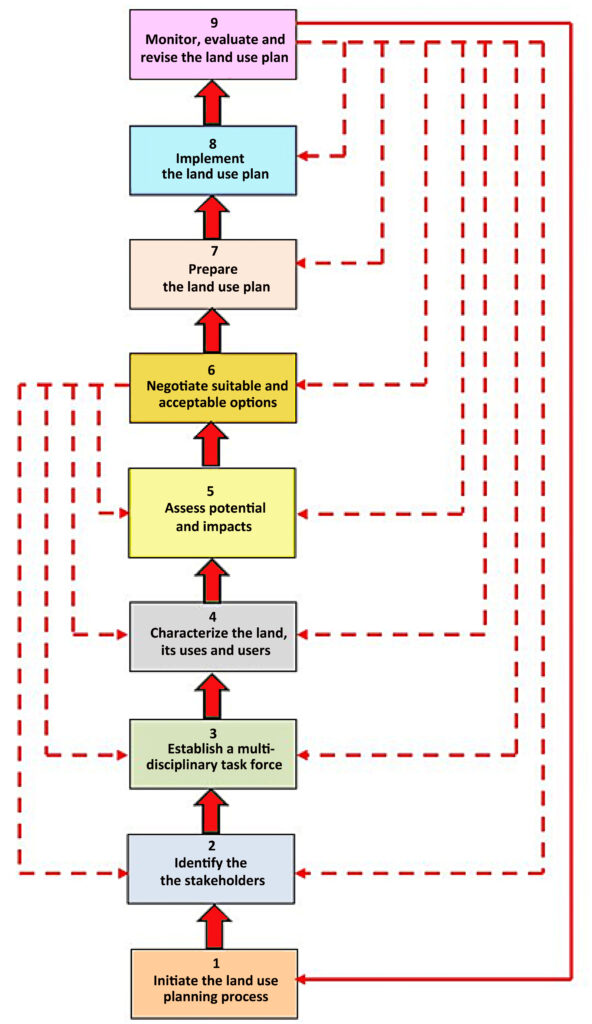
Land use planning is an iterative process: Figure 11 illustrates how the planning process progresses through the logical steps outlined earlier.
Figure 11. Recommended steps in land use planning and potential paths for revision (red)
While Step 9 focuses on verifying whether the process achieves the desired results, in practice, gaining new information and experience often necessitates revisiting earlier steps. During the negotiation and discussion phase in Step 6, it is common to return to previous steps—for instance, by including previously overlooked stakeholders (Steps 2 or 3) or expanding the scope of studies in Steps 4 or 5 (Fig. 11).
Another important consideration is the ‘lifespan’ of a land use plan. Over time, external conditions may change, such as the emergence of new markets for a product or shifts in government policy. When monitoring and revisions (Step 9) are no longer sufficient, planners may need to transition from refining an existing plan to initiating a completely new one—moving from Step 9 of the earlier plan back to Step 1 (Fig. 11, solid red line).