Implementing Integrated Land Use Planning: A step-by-step guide for rural areas
INTRODUCTORY GUIDE: CHAPTER 1. NATURE AND SCOPE
1.5. People in planning
Land-use planning involves getting many different people to work together towards common goals. It is therefore important to recognize the different roles of all agents involved in planning for change.
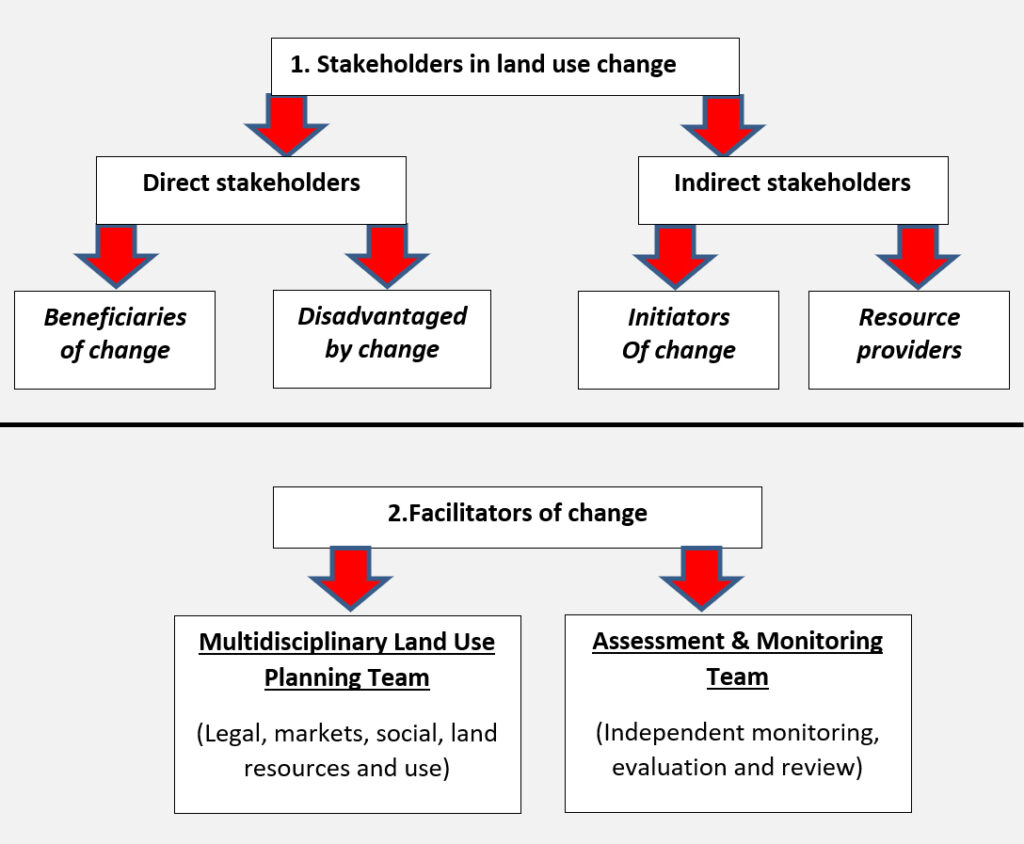
The first group is composed of the Stakeholders, and can be subdivided into ‘direct stakeholders’ and ‘indirect stakeholders’.
| Definition A stakeholder is any person or any institution with an interest in, or is affected by, an issue or activity or transaction, and therefore has a natural right to participate in decisions relating to it. (FAO/UNEP, 1999) |
Direct stakeholders are primarily the land users themselves., This group consists of the people living in the planning area whose livelihood depends wholly or partly on the land. They include not only farmers, herders, foresters and others who use the land directly but also those who depend on these people’s products, e.g. operators in crop or meat processing, sawmills and furniture factories.
The involvement of all land users and legitimate tenure right holders (such as owners of land who do not reside in the targeted area) in planning is essential. Ultimately, they have to put the plan into effect and must therefore believe in its potential benefits as well as in the fairness of the planning process. The latter is certainly important, since any change in land use is likely to produce both ‘winners’ (beneficiaries of change) and ‘losers’(disadvantaged by change).
The experience and determination of local people in dealing with their environment are often the most neglected, as well as the most important, resource. People will grasp development opportunities that they themselves have helped to plan more readily than any that are imposed on them, and more likely to arrive at ‘win-win’ solutions. Without the support of local leaders, a plan is not likely to succeed.
Indirect stakeholders include those people that have concerns related to land use issues and are instrumental in addressing these concerns, without being directly affected by the proposed land use changes.
At national and district levels they are usually government ministries, at local level members of town or village councils or other local authorities. The key role of these initiators and resource providers is primarily to identify the problems to be addressed, assure the legality of the proposed interventions and to mobilize human, financial, and technical resources.
The second group consists of ‘facilitating agents’, namely a technical planning team and a monitoring and evaluation team. These agents have a key role in managing the complex processes and information flows between the various actors in land use planning. This is particularly necessary where different decision-making levels are involved and where the nature of the proposed change requires technical guidance by a multidisciplinary team approach, rather than through actions by individuals.
Ideally the technical planning team is able to provide expertise on the four thematic variables that influence land use (landscape, markets, social norms, legislation) and would therefore contain specialists in natural resources, law, agriculture, economic and social science. In addition, given the risk of the experts getting stuck in their own disciplines, strong leadership by a generalist land use planner is desirable.
Such a range of expertise may only be available at the national level.
At intermediate and local levels, a more typical planning team may consist of a land use planner and one or several technical assistants. These usually will be generalists as they will have to manage a basket of tasks and will often require specialist advice, to be provided by government agencies or universities.
The assessment & monitoring team provides independent evaluations and updates on progress of a major project related to land use change. To ensure their independence they are ideally composed of staff of private companies or government agencies with no stake in the projects under review.
Figure 6 summarizes the various groups involved in a major land use planning exercise.