Implementing Integrated Land Use Planning: A step-by-step guide for rural areas
INTRODUCTORY GUIDE: CHAPTER 1. NATURE AND SCOPE
INTRODUCTORY GUIDE
CHAPTER 1. NATURE AND SCOPE
1.1. Land and land use
In the context of land use planning, “land” has a broad definition. It includes not only the surface layer (the soil) but also the landscape, climate, water resources, vegetative cover, and even the deeper geological structure, as these factors can all influence land use.
Land use refers to the purposes for which land is used, the way it is managed, the inputs applied to it, and the tenure rights that govern its usage.
As illustrated in Figure 1, land use develops as a function of four interrelated variables: landscape, markets, social norms, and legislation.
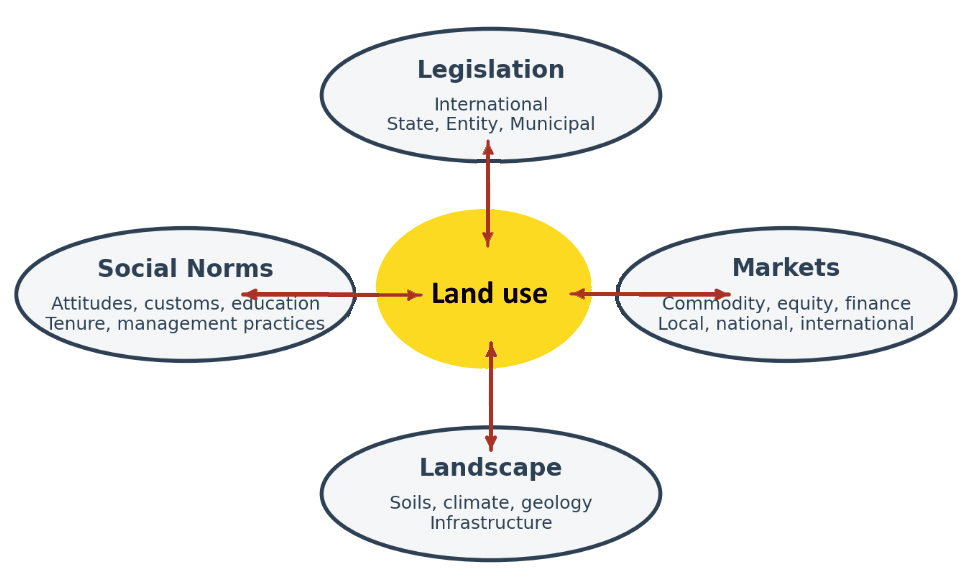
The Landscape variable includes all physical elements that humans interact with, such as natural features (soils, geology, topography, climate, vegetation/land cover, wildlife, and water resources) as well as cultural features (roads, irrigation canals, power grids, pipelines, buildings, sacred sites, and other infrastructure). Understanding land use within this landscape, and the potential impacts of changes, requires input from a variety of experts, including natural and social scientists, agronomists, and engineers.
The Markets variable refers to economic activities and transactions at all levels (local, regional, state, and international). It encompasses both commodity and financial markets. When considering land use changes, the economic implications—gains and losses—must be carefully evaluated.
The Social Norms variable refers to the attitudes, customs, education, and practices of local populations. Variations in these social factors can lead to significantly different land use patterns, even in areas with similar landscapes. Understanding these factors requires the expertise of sociologists and anthropologists.
Legislation encompasses the laws, regulations, and policies established by societies to control and guide the activities of their members. These laws, particularly those governing land tenure and ownership, are crucial to land use planning. Land tenure can be regulated through statutory law or be based on customary practices, each carrying its own legitimacy. Issues surrounding land tenure and ownership are critical in land use planning, and evaluating their impacts requires the expertise of political scientists, administrators, surveyors, and lawyers.
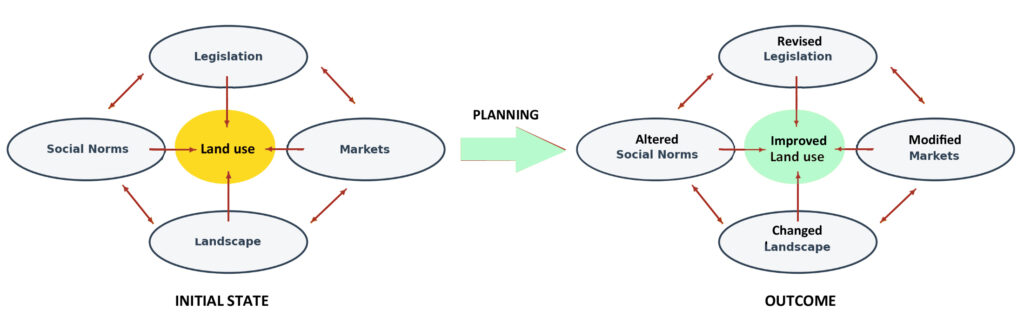
Each of these variables interacts with the others to create specific land use patterns in a given area. This means that in order to implement necessary or desirable changes in land use, planning must account for adaptations in one or more of these interrelated variables (see Figure 2).